Lead in Indiana Service Lines and Home Plumbing: A Homeowner’s Guide
Lead can enter tap water from a service line or plumbing inside a home, and a utility-wide report cannot tell you exactly what is happening at your faucet. This guide explains how to check your line, understand Indiana’s inventory and testing options, and choose sensible next steps without mistaking a listing or a test result for the whole picture.
How lead can reach a household tap
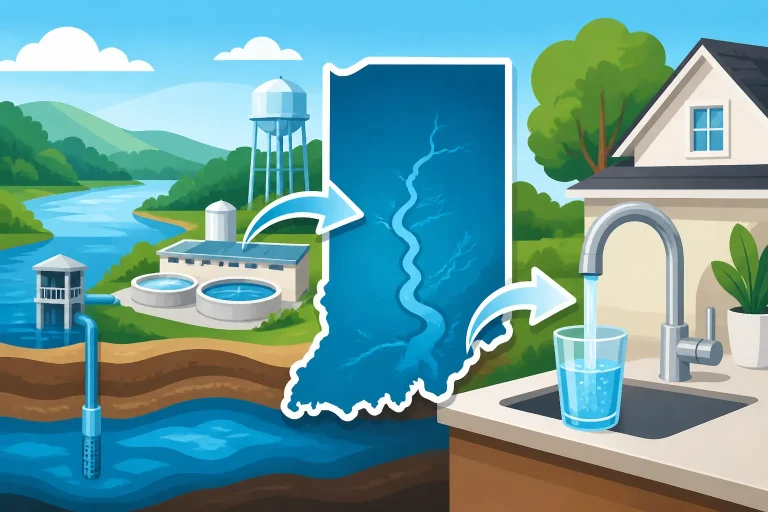
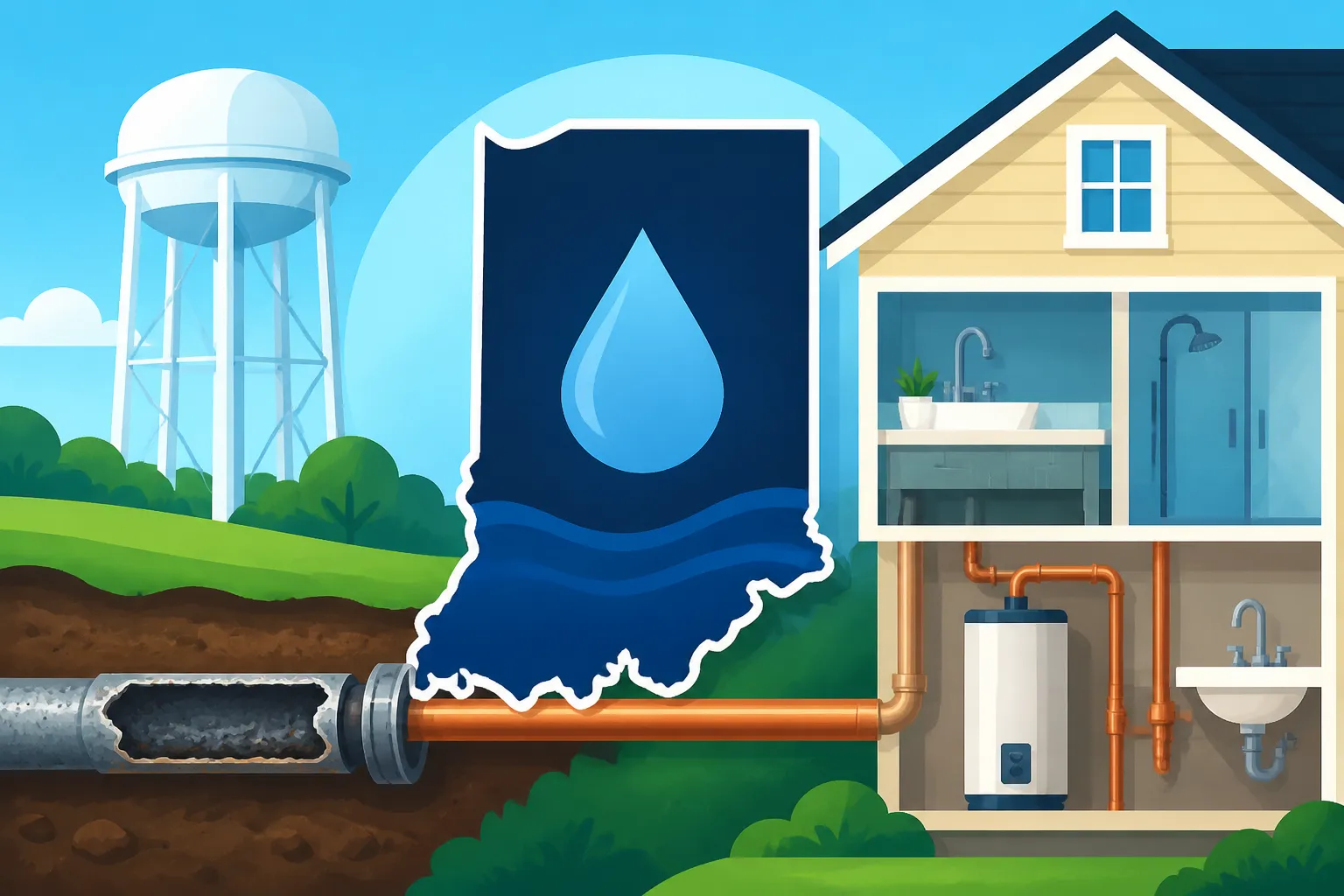
Lead in drinking water is often connected to plumbing rather than the water source itself. Water can pick up lead as it moves through a lead service line, lead-containing solder, or certain plumbing fixtures and fittings. A home may have more than one possible source, and the pipe leading from the water main is only part of the path.
A service line is the pipe that connects a water main to a building. It may include a utility-owned portion and a customer-owned portion. Which organization or property owner is responsible for a particular section depends on the system and local arrangements; do not assume that one person owns the entire line. For a closer look at the dividing point, see Who Owns Which Part of an Indiana Water Service Line?.
Inside the property, water may pass through pipes, joints, faucets, and other plumbing components before reaching a glass. Older plumbing may contain materials that can contribute lead. A service line that is not lead does not automatically rule out a lead source inside the home. Conversely, a lead service line listing signals a concern to investigate, but it does not by itself tell you the lead concentration at a specific tap.
Lead can also vary from one faucet to another. Water that sits in a particular pipe or fixture may have different results from water collected after it has been flushed. A sample from one tap therefore describes the water under the conditions used to collect it; it does not necessarily describe every tap or every use in the home.
Keep these distinctions in mind:
- The source of the water is not necessarily the source of lead. Public water systems treat and monitor water, but lead can be added as water passes through plumbing.
- The service line is not the whole plumbing system. Fixtures, solder, and indoor pipes may also matter.
- A pipe-material record is not a water test. It gives information about the pipe, not the measured lead concentration at your faucet.
- A water test is a result for a sample collected under particular conditions. It does not identify every possible lead-bearing component by itself.
- A system-wide report is not a result from your individual kitchen faucet. For more context, see Does a System-Wide Report Describe the Water at Your Own Indiana Tap?.
Indiana public water systems have responsibilities for monitoring and communicating about lead, but an individual household may still need to check its service line and plumbing. The Indiana Department of Environmental Management (IDEM) requires public water systems to test for lead and, when necessary, take steps to educate and protect consumers. That system-level work is important, but it is not a substitute for finding out what materials are present at a particular property or arranging a tap sample when one is appropriate.
What Indiana’s service line inventory can and cannot tell you
Indiana’s service line inventory is a useful place to begin if you are on a public water system. The Lead and Copper Rule Revisions require public water systems to inventory all lines in their system, including the portions owned by the utility and the customer. The inventory is meant to describe service line materials across the system, not to provide a laboratory measurement of water at each home.
According to IDEM, Indiana public water systems were required to submit their Lead Service Line Inventories to IDEM by Oct. 16, 2024. IDEM says the submitted inventories can be viewed on 120Water’s Service Line Inventory – State of Indiana site. You can also ask your water supplier how it identifies the material listed for your address and what to do if the record is missing or unclear.
All community water systems and non-transient non-community water systems must inventory every service line connected to the distribution system, including ALL service lines (including those not in use). That inventory requirement is broad, but a result for a particular property may still need follow-up. Records can be incomplete, a line’s material may be unknown, or the inventory may not show all the plumbing on private property.
| What you find | What it can tell you | What it does not establish |
|---|---|---|
| Lead service line listed | The recorded service line material includes lead, so ask the utility what steps it recommends for the property | The lead concentration at your tap or whether indoor plumbing also contributes |
| Non-lead material listed | The inventory records a material other than lead for the service line | That every pipe, fitting, solder joint, or fixture inside the home is lead-free |
| Unknown or unresolved material | The utility has not confirmed the line material in the record | That the line is lead-free or that it is definitely lead |
| No matching address result | The lookup did not provide a usable record for the address | That no service line exists or that the plumbing has been checked |
| Tap-water test result | The concentration measured in the submitted sample under its collection conditions | The material of every plumbing component or the result at every other tap |
An inventory is a starting point, not a warranty about the water. If the address result is marked unknown, ask the utility what information it has and how the material can be confirmed. If a search returns no result, check that the address is entered in the form the utility uses, then contact the water supplier through its official website. You can also use No Map Result for Your Address? Asking for a Service Line Check for practical follow-up.
A listed material may reflect information collected from utility records, customer reports, inspections, or other methods. Ask the utility how it arrived at the classification and whether the customer-owned section has been verified. If you have old plumbing records or can safely see exposed pipe, those details may help, but they should not be treated as definitive without the utility’s instructions or an appropriately qualified professional’s assessment.
Do not dig to identify a buried line on your own. A service line may be underground, and excavation can damage utilities or property. If physical confirmation is needed, ask the water supplier what inspection method is appropriate and who is authorized to perform it. For a step-by-step approach to the address lookup and the utility-owned and customer-owned portions, see How to Check Both Sides of Your Indiana Service Line by Address.
The inventory requirement is not the same thing as a requirement that every line be replaced immediately. IDEM describes the EPA’s goal as removing 100% of lead service lines in use. A goal is useful context for understanding the direction of the program, but it does not tell an individual household when its line will be replaced, who will pay for each part, or what interim steps apply. Ask your utility for the current plan for your specific property rather than relying on a general inventory entry.
How to check the service line and indoor plumbing
A careful check uses more than one kind of information. Start with the utility’s record, then look for available property documentation, and ask the utility what it can confirm. If the concern is the water itself, arrange a sample using instructions from a qualified lab or the relevant public agency. No single step answers every question.
Start with the utility record
Search the address in the inventory or ask the utility to look it up. Save or note the result and the date you checked it. If the material is listed as lead, ask whether the listing applies to the utility-owned section, the customer-owned section, or both. If the entry says unknown, ask what the utility needs to resolve it and whether it offers an inspection or other verification.
A pipe-material lookup and a lead test answer different questions. The inventory helps identify the recorded material of the service line. A lab sample measures lead in the water collected from a particular tap under stated conditions. If the utility confirms that the service line is not lead, you may still want to ask about old indoor plumbing, fixtures, or solder.
Gather property and plumbing information
Look for plumbing records from previous work, renovation documents, or information provided when the property was purchased or rented. These records can help establish what has been repaired or replaced, but do not assume that a repair covered the whole route from the main to the faucet. A replacement may have addressed only one section, or older components may remain elsewhere.
If pipe is visible without moving walls or disturbing equipment, a qualified plumber may be able to assess it. Appearance alone is not a reliable way to identify all materials, particularly where pipes are painted, concealed, or joined to other components. Avoid scraping, cutting, or sanding a pipe to identify it; that could disturb material and create additional exposure or cleanup concerns.
For older properties, pay attention to the whole route of the water: the service line, the indoor supply piping, connections, and fixtures. A lead-free-looking faucet does not prove that the pipe behind the wall or under the yard is free of lead. Likewise, replacing an interior fixture does not resolve a potential service line concern.
Decide whether water testing is useful
If you need to know whether lead is present in water from a particular tap, ask about a properly collected sample. The Indiana Department of Health (IDOH) Health Laboratories offers lead and copper testing. Before collecting a sample, confirm the laboratory’s current instructions, including the container, tap selection, preparation, sample handling, and submission process. Collection details can affect how useful the result is.
Ask the lab or utility what the sample is designed to show. A first-draw sample, a flushed sample, or a sample collected after a period of stagnation may answer different questions. Follow the specific instructions rather than creating your own sampling procedure. Do not rinse a laboratory bottle unless the lab tells you to do so, and do not transfer water between containers unless instructed.
If you are sampling because of a known or suspected lead line, make sure the lab or utility understands the concern. Ask whether it recommends sampling one faucet or more than one, and whether the sample should be collected under a particular condition. For more detail on sample collection and interpreting results, see Sampling Your Own Tap to Check What Indiana Home Plumbing Adds and Lead in Indiana Drinking Water: Testing, Results and Next Steps.
Keep the records together
Save the inventory result, utility correspondence, laboratory instructions, sample report, plumbing invoices, and any written recommendations. Note which faucet was sampled and how the sample was collected. That context can help you compare later results or explain the situation to a landlord, plumber, utility, or health professional.
If a result is unexpected, first check the sample information and units on the report. Confirm with the laboratory or agency what the reported result means and whether a follow-up sample is appropriate. A second result may be helpful, but it should be collected and interpreted under the lab’s directions rather than treated as a casual repeat.
Understanding lead results and action limits
A reported number can be difficult to interpret without knowing what was measured, where the sample came from, and what comparison value applies. A result from a home tap is not the same as a system-wide monitoring result, and an action limit is not a promise that every sample below it has no lead.
According to IDOH, the lead action limit in drinking water is 15 ppb, and the copper action limit is 1300 ppb. IDOH also states that lead-assessor water testing uses an action limit of 0.015 ppm and that there is no safe level of lead in water. These figures describe action limits used in the stated contexts; they should not be read as a threshold at which lead suddenly becomes harmless.
Pay close attention to the units shown on your report. If the report uses a different unit from the comparison value, ask the laboratory or a qualified professional to confirm the conversion before drawing conclusions. Do not compare numbers just because they look similar; confirm that the result and the benchmark use compatible units and refer to the same type of sample.
The meaning of a result also depends on the sampling method. A sample collected after water has been sitting may capture conditions that differ from a flushed sample. A sample from one faucet does not automatically represent the water from every other faucet. If the report does not explain how the sample was collected, contact the lab that performed the analysis and ask what the result can and cannot show.
A result below an action limit does not identify the plumbing materials, and it does not prove that every future sample will be the same. A result at or above an action limit deserves careful follow-up with the laboratory, utility, and, where appropriate, a health professional or local health department. Do not try to diagnose a health effect from a water report. For health questions, contact a local health department or medical professional.
When you review a water quality report, distinguish utility monitoring from a sample taken at your own faucet. A utility report can help explain system-level monitoring and results, but it may not describe conditions inside your home’s plumbing. Indiana Consumer Confidence Reports: How to Find and Read Yours explains how to locate and read the annual report, while Which Year Does an Indiana Water Quality Report Actually Cover? helps clarify the period a report describes.
What to do while you investigate
If a service line is listed as lead, the material is unknown, or a tap test raises concern, take a measured approach. First, contact the utility and ask what it knows about the service line and what guidance applies to your property. Ask for instructions in writing when possible, especially if you need to coordinate sampling, access, or planned work.
Use water only as advised by the utility or relevant health authority if there is a specific notice or instruction. General advice for one situation may not fit another, so do not rely on a neighbor’s directions or assume that an advisory applies to your address. If you receive a notice, confirm the affected area and current instructions through the utility’s official communication channels.
Boiling water is not a method for removing lead. If you are under a lead-related concern, do not assume that boiling makes water appropriate for drinking or cooking. See Does Boiling Water Remove Lead? What Indiana Utilities Tell Customers for the distinction between lead concerns and instructions for other types of water notices.
Flushing can be part of utility guidance for some circumstances, but the appropriate procedure depends on the situation and the utility’s advice. Do not invent a flushing schedule or assume that flushing resolves a lead service line. Follow directions from the utility and use cold water for drinking and cooking if that is the guidance provided. If you are unsure whether a recommendation applies to your home, ask the utility directly.
A filter may be an interim option in some circumstances, but it must be selected and maintained for the specific purpose. Check that the exact model and replacement cartridge are certified or otherwise documented for lead reduction, and verify that the certification matches the claim you need. Installation location matters: a point-of-use device treats water at a particular tap, while a whole-house system is intended to treat water at multiple outlets. Neither approach identifies or removes lead-bearing plumbing.
A filter is not a replacement for fixing a lead source, and it should not be described as preventing or treating a health condition. Follow the manufacturer’s installation and cartridge-change directions, and ask the utility or a qualified professional what use is appropriate for your result and household. More on product selection and upkeep is available in Lead Filters for Indiana Homes: Certifications, Types and Upkeep.
If a child, pregnant person, or another household member may have a health concern, ask a medical professional or local health department for advice. A water test can inform a water-quality question, but it is not a medical test and cannot determine an individual’s health status.
Replacement, responsibility, and household coordination
The service line may cross both public and private property, and responsibility may be divided between the utility and the customer. Do not assume that the utility will replace every portion at no cost, or that a customer is expected to arrange work without first confirming the utility’s process. Ask who owns each segment, what replacement work is planned, and whether the utility needs to inspect or coordinate the project.
If the service line is confirmed or suspected to contain lead, ask the utility:
- Which portions of the line are included in the record?
- How was the material classification determined?
- What steps are planned for this address?
- Who is responsible for coordinating work on each portion?
- What, if anything, should residents do before, during, and after work?
- Whether the utility recommends a water sample before or after replacement.
- How residents will receive updates or instructions.
If work is planned, keep the written scope and completion records. Confirm whether the project addresses the full service line or only a portion, and ask what happens to any lead-containing material that remains. After work, follow the utility’s flushing or sampling instructions rather than assuming that the line can be used normally without any follow-up. Before, During and After a Scheduled Lead Line Swap at an Indiana Home covers the kinds of questions residents can raise before work begins.
For a rental, the tenant may not control the service line or indoor plumbing work. The landlord may have records or authority to arrange access, but renters should still be able to ask for relevant water-quality and pipe information. Contact the utility for system information and ask the property owner or manager about plumbing records, planned repairs, and any notices received. For more on passing along notices and responsibilities, see Landlords and Lead Line Notices: Passing Them On to Indiana Tenants.
If there is disagreement about the line’s material, who must arrange work, or how the water result should be interpreted, keep copies of communications and ask each party to explain its position. A utility can clarify its inventory and service-line process; a landlord or property owner can address building plumbing and access; a laboratory can explain a sample report. These are related but distinct responsibilities.
A practical decision path for homeowners
Use the steps below to keep the investigation focused and avoid spending money before you know what question needs an answer.
- Check the utility’s service line inventory. Record whether the line is listed as lead, non-lead, unknown, or not found. If the result is unclear, contact the utility and ask what it means for the address.
- Ask about both portions. Confirm whether the utility’s information covers the utility-owned and customer-owned portions, and ask how the material was identified.
- Review available plumbing information. Look for records of service line or indoor plumbing work, but do not treat an incomplete repair record as proof that all potential sources are gone.
- Ask whether a tap sample is appropriate. Contact the utility or IDOH Health Laboratories for current sampling directions and confirm what the sample is intended to measure.
- Read the report with its context. Check the sample location, collection instructions, units, and any interpretation provided by the lab.
- Follow the appropriate interim guidance. Use utility instructions for the service-line concern and verify any filter claims against the specific lead-reduction need.
- Plan any repair with the right parties. Clarify ownership, scope, coordination, and post-work instructions before scheduling service.
- Keep records and follow up. Save results and communications, and ask whether further testing or verification is recommended.
The main aim is to answer separate questions in order: What is the service line made of? Could indoor plumbing also contribute lead? What does a properly collected water sample show? Who can address each part? Keeping those questions separate makes it easier to choose the next step and avoid assuming that a single lookup, test, or filter resolves every concern.
Frequently Asked Questions
Does a lead service line listing prove that lead is in my tap water?
No. A listing identifies recorded service line material, not the lead concentration at a particular faucet. A tap-water sample can measure lead in the collected water, but it does not identify every plumbing component.
Does an unknown entry mean the line is lead-free?
No. Unknown means the material has not been confirmed in the inventory. Ask the water supplier what information it has and how the line can be checked.
If the service line is not lead, can indoor plumbing still matter?
Yes. Pipes, solder, fittings, or fixtures inside the property may be relevant even when the service line is recorded as a different material. If you have concerns about water at a particular tap, ask about appropriate sampling.
Does boiling remove lead from drinking water?
No. Boiling is not a way to remove lead. Follow utility or health-agency instructions for the specific water concern, and ask the utility if you are unsure what applies.
Is a filter a permanent solution to a lead service line?
No. A properly selected and maintained filter may be considered for a specific interim use, but it does not replace identifying and addressing a lead source. Verify that the exact model and cartridge are certified for the reduction you need.
Sources
- Indiana Department of Environmental Management — Water Quality in Indiana: Drinking Water and Lead (checked November 13, 2026)
- Indiana Department of Health — Environmental Public Health: Well Water Quality and Testing (checked November 13, 2026)
- Indiana Department of Health — IDOH Laboratory: Water Testing (checked November 13, 2026)
Disclaimer
This article is for general informational purposes only and does not constitute professional advice. Laws, prices and regulations vary by location and change over time. Consult a qualified professional for guidance on your specific situation. Indiana Water Guide is not a government agency or water utility and is not affiliated with any public water system.