Indiana Consumer Confidence Reports: How to Find and Read Yours
Indiana’s annual water report can look like a wall of chemical names, sample dates, and unfamiliar limits. The key is to confirm that you have the report for the utility serving your home, then read the results as a system-wide snapshot—not a test of your individual faucet. Here’s how to find your report, understand its tables, and know what to ask next.
What a Consumer Confidence Report Can and Cannot Tell You
A Consumer Confidence Report, often called a CCR or annual water quality report, summarizes drinking-water information for a public water system. It can help you understand where the system’s water comes from, what substances were tested for or detected, and whether the utility reported any violations. It is a useful starting point for questions about your tap water, but it does not answer every question about water inside your home.
The Indiana Department of Environmental Management says community water supply Consumer Confidence Reports are available “via your water provider or through the Drinking Water Viewer.” That gives you two practical routes: start with the utility that sends or bills you for water, or look for the system in the state’s viewer.
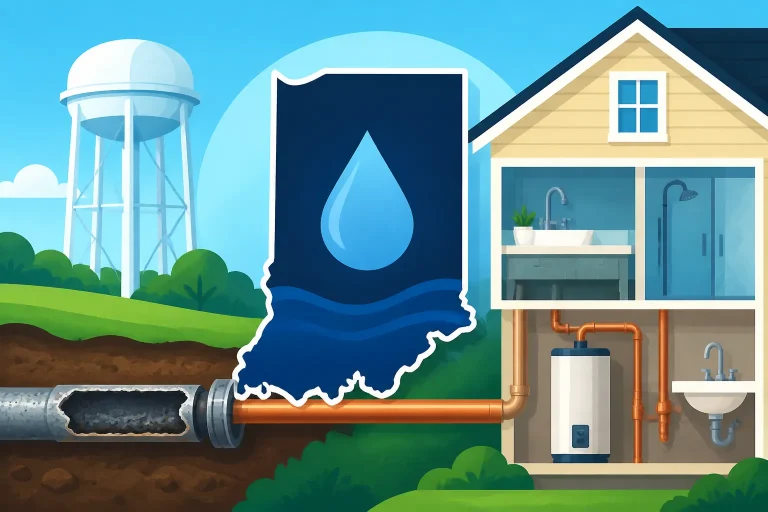
A CCR describes a public water system, not necessarily the water at the exact faucet you use. A report may cover a broad service area and summarize results from approved sampling locations. Your building’s plumbing, service line, fixtures, or treatment equipment can affect water between the system and your tap. For that reason, a reassuring system-wide report is not the same thing as an individual sample from your kitchen faucet.
If you want background on the way public systems are tested and overseen, see How Indiana Public Drinking Water Is Tested and Regulated. For a closer look at the origins and treatment of water before it reaches a home, Where Your Indiana Tap Water Comes From: A Homeowner’s Guide can help put the report’s source information in context.
A report also represents a reporting period rather than a live reading of today’s water. The results and explanations may be the latest information included in that particular document, but a utility may have newer sampling results or notices. If your concern is about a recent change in taste, color, odor, or pressure, the annual report alone may not tell you what is happening now. Finding Current Water Quality Information for Your Indiana Address covers ways to look for more current information.
A CCR is most useful when you treat it as a starting point for specific questions:
- Which water system serves this address?
- What source does the system use?
- Which substances appear in the results table?
- What units and limits are used for each result?
- Does the report describe a violation, a monitoring issue, or neither?
- Is there newer information for the system?
- Could the concern be specific to the home’s plumbing rather than the public system?
It is also important to distinguish a reported detection from a report of a violation. A substance can be detected without the report saying the system exceeded a regulatory limit. Conversely, a report may contain a violation or monitoring notice that deserves a closer look even if it is not presented as a high concentration in a results table. The wording and context matter; a single row should not be interpreted without its column headings and explanation.
A CCR is not a private-well report. Private wells are not described by a nearby community system’s report, even if neighbors receive water from that system. If you are unsure whether your home uses public water or a private well, City Water or a Private Well? How to Tell What Your Indiana Home Uses can help you sort that out.
Find the Report for Your Indiana Address
Start by identifying the water provider that serves the property. A current bill is often a convenient clue, but it may not be in your name if you rent, live in a managed building, or pay water charges through a landlord. Ask the property manager or landlord which provider serves the building if the bill does not make that clear. A nearby city name alone may not identify the supplier: some communities buy water from another utility, and service boundaries do not always match municipal boundaries.
If you already know the provider, look for an annual water quality report or Consumer Confidence Report on its official website. Search the provider’s site for terms such as “water quality report,” “Consumer Confidence Report,” or “annual report.” Check that the report identifies the utility or water system you expect and that its service-area description fits your address.
If you do not know the provider, the Indiana Department of Environmental Management’s Drinking Water Viewer provides information about a public water supply’s source, sampling results, and contact person—described by IDEM as “where your water comes from, sampling results, and who to contact.” Use that information to identify a likely system and confirm it against your bill, property records, or the provider’s official information.
The Viewer also provides public water system monitoring schedules and sample results. IDEM describes these as “monitoring/sampling schedules, drinking water sample results, and other information.” That can be useful when a report is hard to locate or when you want to investigate information beyond the annual summary.
Use the Viewer as a way to locate and understand information, not as a substitute for confirming that the system serves your specific home. If a search produces more than one plausible system, or the address does not return a clear match, contact the water provider and ask which public water system serves the property. The provider’s official website is the place to find current contact details.
The Indiana Department of Health’s EPA Drinking Water Basics link provides access to “Consumer Confidence Reports, Home Water Testing, Lead in Drinking Water, and Private Drinking Water Well information.” That collection can help you move between related topics, but the utility’s report and the state’s Drinking Water Viewer are the most direct places to look for a particular community system’s report and results.
Public water suppliers began distributing annual quality reports in 1999, according to Purdue University Cooperative Extension Service. Confirm the report history for a particular provider with the official agency or provider, especially if you are looking for older documents or trying to determine whether a report is missing.
If you cannot find a report online, ask the provider where it publishes the report and whether it can supply a copy. Purdue University Cooperative Extension Service says public water suppliers’ test results are “available upon request”; confirm availability and the process with the official agency or provider. For more help tracking down a missing report, see Can’t Find Your Utility’s CCR Online? Other Ways to Get It in Indiana.
Match the Report to Your Home and Water Provider
Finding a report is only useful if it belongs to the right system. Similar utility names, neighboring towns, purchased water, and multiple service areas can make it easy to open a report that seems local but does not cover your address. Before interpreting a result, check the report’s identifying details.
Look for the provider or system name, the service area described, and any explanation of which communities or customers are included. Compare those details with your water bill or information from the landlord or property manager. If the report describes a system that supplies water to another provider, the name on your bill may differ from the name on the report. Ask the provider to explain which report applies to your home.
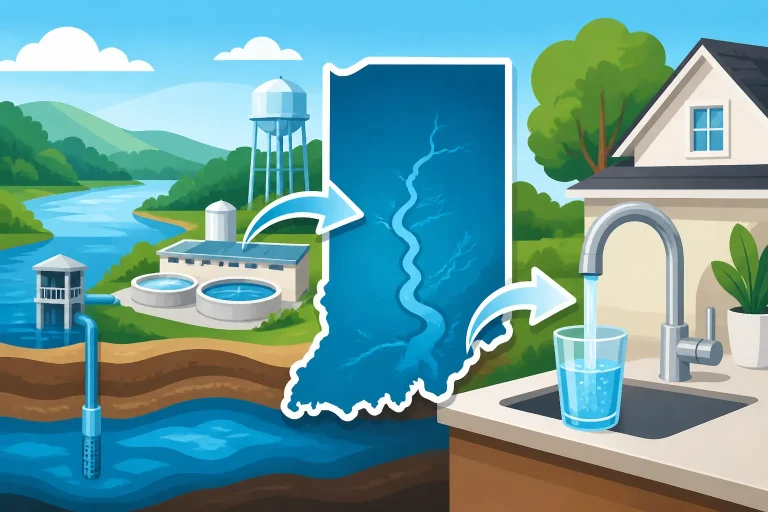
A home may also receive water from a system that draws on more than one source or buys treated water from another supplier. Do not assume that the nearest river, reservoir, or well is the source for your address. Check the source explanation in the report or in the Drinking Water Viewer. Wells, Rivers, Reservoirs or a Blend: Indiana’s Public Water Sources explains why a system’s source can take more than one form.
Then check the report’s coverage period. A CCR is an annual summary, but the sampling dates shown for particular substances may differ. A report’s cover page or introductory text should help you understand what information it summarizes. If you need results from a more recent sample, ask the provider or look in the Viewer rather than treating the annual report as a current reading.
If you rent, do not assume that the landlord’s water arrangement means a different report applies. The building may receive public water from the same system serving nearby homes, or it may have a separate arrangement. Ask which utility serves the property and request the report that covers the building. For tenant-specific questions, Do Indiana Renters Get the Annual Water Report Without a Water Bill? offers more detail.
The report may describe a system-wide result, while the question you care about is local to a tap. For instance, you may be concerned about a building’s older plumbing, a fixture, a service line, or water that has been sitting in the pipes. A CCR cannot establish the condition of every home’s plumbing. For service-line questions, How to Check Both Sides of Your Indiana Service Line by Address can help you investigate the line, and Sampling Your Own Tap to Check What Indiana Home Plumbing Adds covers why a household sample may provide different information.
If the report lists a system contact person, that can help you direct questions about its coverage, source, and sampling. The Viewer’s contact information is a starting point, but use the official utility website to verify current contact details. When asking, be specific: give the property address, explain which report you found, and ask whether the system and service area match the home.
Read the Results Table Without Getting Lost
The results table is often the most technical part of a CCR. Resist the urge to scan only for a substance name or a number. Read the full row, including the column labels, units, notes, and any explanation elsewhere in the report. Those details determine what the result means.
A table may list a substance, the units used to measure it, the result or range, a limit or comparison value, and a note about the source or potential effects. The exact layout varies. If you see an unfamiliar heading, look for a glossary or explanation in the report before drawing a conclusion.
| Part of the report | What to check | Why it matters |
|---|---|---|
| Substance name | Confirm the name and whether it refers to a specific form or group | Similar names can refer to different substances or measurements |
| Result | Check whether the entry is a measured value, a range, an average, or a detection statement | One number may summarize samples differently from another |
| Units | Read the unit printed in the same row | Results cannot be compared reliably if the units differ |
| Limit or benchmark | Identify what kind of comparison value the report gives | A regulatory limit, goal, and other benchmark do not mean the same thing |
| Sampling information | Look for dates, locations, and notes about the sample | The context can explain what the result represents |
| Violation or compliance note | Read the explanation associated with the result | A detection alone does not establish that a limit was exceeded |
Understand detections and non-detections
A detection means the substance was found in the sample at a level the testing could report. It does not by itself say that the result exceeded a limit or that the system violated a requirement. Compare the result with the applicable comparison value, and read any report explanation.
A non-detection does not necessarily mean that no molecules were present. It generally means the result was below the level the test could report, or that the substance was not detected under the testing method used. The report’s wording and any notes about detection limits matter. If the meaning is unclear, ask the provider what the result indicates and what the test could detect.
Compare like with like
Units are easy to overlook. A result expressed in one unit cannot be compared directly with a limit written in a different unit unless the values are converted correctly. The report may use abbreviations that look familiar but are not interchangeable in every context. Use the unit shown beside the result and comparison value, and ask the provider to clarify if the units differ.
Do not compare a result in one report with an online chart or another utility’s report unless the substance, units, sampling method, and comparison basis are all appropriate. Two figures can look different for reasons that have nothing to do with a change in water quality.
Read the limit column carefully
Reports may explain several kinds of comparison values. A maximum contaminant level, or MCL, is a regulatory limit. A maximum contaminant level goal, or MCLG, is a different kind of value; it is not the same as a compliance limit. Other entries can use action levels or health advisories, which also have specific meanings. Do not treat every number in a comparison column as the same kind of standard.
A result below a listed limit is not the same as a guarantee that every tap in every home has the same result. It describes the tested system or sample under the conditions shown. If your question is about a particular house, plumbing material, or faucet, you may need an address-specific service-line check or a properly collected tap sample.
Notice the sample type and location
The report may describe results collected at the treatment plant, in the distribution system, or at selected customer locations, depending on the substance and sampling program. The location helps explain what the result can represent. A sample taken at a system monitoring point is not a sample from your kitchen faucet.
If a report lists a result without an obvious sample location or date, look for an explanatory note or ask the provider how the result was collected. Sample timing, collection instructions, and sample location can all affect how results should be interpreted. For household sampling, follow the lab’s instructions rather than improvising; How to Get Water Tested in Indiana: Labs, Kits and Costs explains how to choose an appropriate testing route.
Understand Violations, Monitoring Notes, and Follow-Up
A CCR can include more than a table of measured substances. It may explain a violation, a missed or incomplete monitoring requirement, a special notice, or a step the utility took in response. Read those explanations even if no result in the main table looks unusual.
A violation generally means the report says a requirement was not met. That is not automatically the same as a statement that every customer’s water was unsafe, nor does it tell you by itself what action is appropriate for your household. The report should explain the issue and may describe what the system did or needs to do. If that explanation is unclear, ask the provider what requirement was involved, what period it covered, and whether there is any current instruction for customers.
A monitoring or reporting violation can be different from a finding that a substance exceeded a limit. The system may have failed to complete required sampling or reporting as expected. That still deserves attention: without the required data, the report may not provide the same assurance as a completed monitoring result. Look for the report’s explanation and any later sample information. Missed Monitoring Violations in an Indiana Water Report, Explained can help make that distinction clearer.
A result that is above a listed comparison value also needs context. Check the substance, units, sample period, and report explanation. Do not assume that a single result has the same meaning as a system-wide violation, or that an old entry describes conditions today. Ask the provider whether there are follow-up results, a current notice, or specific instructions for customers.
If the report mentions a violation or unusual result, useful questions include:
- What requirement or comparison value does the report refer to?
- What samples or monitoring period are involved?
- Has the provider collected follow-up samples?
- Is there a current customer notice or recommendation?
- Does the provider have newer results than the annual report?
- Does the result describe the whole system, a sampling location, or another defined group?
Use the provider’s official website to find current contact details and any current notices. If the question involves an immediate advisory or outage, an annual report is not the right place to confirm whether the advisory is active. Where Indiana Utilities Post Outage and Water Quality Notices and Is the Boil Order Over? How Indiana Residents Can Confirm It address current-notice questions.
If a report raises a question about possible health effects, do not try to diagnose risk from a table alone. Ask the local health department or a medical professional about health questions, and ask the water provider about system results and customer instructions. A report is a source of water-system information, not individualized medical advice.
Know What the Report Leaves Out
A CCR is designed to describe a public water system’s water quality information. It is not a complete investigation of every possible issue at every property. Understanding those limits helps you avoid both false reassurance and unnecessary alarm.
It does not test your faucet
The report’s results are not usually collected from each household. Water can change as it passes through a service line, building plumbing, fixtures, or home treatment equipment. If you have a concern about lead or another substance that could come from plumbing, the system’s report may not settle it. A tap sample collected and analyzed appropriately may be more useful for a home-specific question.
Lead is a clear example of why the distinction matters: a system-wide report cannot establish that an individual home is free of lead-related plumbing concerns. Lead in Indiana Service Lines and Home Plumbing: A Homeowner’s Guide explains the possible places lead can enter water, while Lead Testing in Indiana Drinking Water: Testing, Results and Next Steps covers testing and follow-up.
It does not cover private wells
A community water report applies to the public water system described in the report. It does not describe a nearby private well, even if the well is in the same town or county. Private well owners need information and testing specific to their own water source. The Indiana Department of Health’s EPA Drinking Water Basics link also provides access to private drinking water well information.
If your home uses a well, do not use a community CCR as a substitute for a well test. Private Wells in Indiana: A Guide to the Water You Manage Yourself explains the different responsibilities and questions that come with a private supply.
It may not reflect a recent change
An annual report summarizes information for its coverage period. A water main break, treatment change, current advisory, or unusual change at your tap may not be reflected in the report you have open. For a recent concern, check current utility notices and ask the provider whether newer information is available.
It does not prove that a home treatment device is appropriate
The report can help you understand system information, but a treatment device should be matched to a specific need. A detection in a report does not automatically mean a household filter is necessary, and a general-purpose filter should not be assumed to reduce every substance. If considering a device, check what it is certified or designed to reduce and compare that claim with the contaminant and results you are concerned about. Getting Started With Water Filters and Softeners in Indiana offers a test-first approach to treatment choices.
A Practical Way to Review Your Report
A steady process makes a dense report easier to use. Keep the report, your water bill or provider information, and any relevant home plumbing details together so you can see which questions belong to the system and which belong to the property.
-
Confirm the water source for the property. Check a bill, ask the landlord or property manager, or use the Drinking Water Viewer to identify the likely public system. If the home uses a private well, look for well-specific testing information instead of relying on a community CCR.
-
Verify that the report covers the address. Check the provider name and service-area description. If the provider buys water or uses another system’s supply, ask which report applies to customers at the property.
-
Check the report period and source description. Note what period the report summarizes and what the utility says about its water source. If you need newer information, look in the Viewer or ask the provider.
-
Read the introduction before the table. The introduction often explains the source, treatment, testing, and terminology used in the report. This context can prevent a result from being read out of context.
-
Choose the row that relates to your question. Read the whole row, including units, sample information, limit or benchmark, and notes. If you are not sure what a column means, find the report’s glossary or ask the provider.
-
Check for violations and monitoring explanations. Look beyond the results table for a notice or compliance section. Find out whether the report describes a detected substance, a limit exceedance, a monitoring issue, or another type of event.
-
Decide whether the question is system-wide or home-specific. A report can answer questions about the public supply, but a tap sample, service-line record, or plumbing review may be more relevant to a concern inside the home.
-
Ask a focused follow-up question. Include the property address, report name, substance or row, and what you want clarified. Ask whether newer results or current instructions are available, and use the provider’s official website to find current contact details.
This process is also useful when comparing reports over time. Compare the same system, substance, units, and type of result. Check whether the sampling information and reporting context are comparable before concluding that a value rose or fell. A change in the table layout, units, or sampling description can make a simple side-by-side comparison misleading.
If you are trying to understand a particular row, start by writing down the substance name, result, units, comparison value, and sample information exactly as shown. Then ask the provider to explain the row using those details. That is more likely to produce a useful answer than asking only whether the water is “safe,” because the provider can address the measurement and the report’s meaning directly.
Frequently Asked Questions
How do I find the Consumer Confidence Report for my Indiana home?
Start with the water provider serving the address and check its official website. The Indiana Department of Environmental Management also makes community water supply reports available “via your water provider or through the Drinking Water Viewer.” If you are unsure which system serves the property, use the Viewer and confirm the match with the provider.
Does a Consumer Confidence Report tell me what is in my own faucet?
Not necessarily. A CCR summarizes information for a public water system and does not test every home’s plumbing or faucet. If your concern is specific to the property, ask about a suitable tap sample or investigate the home’s service line and plumbing.
Does a detected substance mean the water system violated a limit?
Not by itself. Read the result alongside the units, comparison value, sampling information, and report notes. A detection and a violation are different kinds of information; ask the provider to explain a row that remains unclear.
Can I use a community report for my private well?
No. A community water report describes the public system it identifies, not a private well nearby. Private well owners need well-specific information and testing.
What should I do if I cannot find the report?
Check the provider’s official website and the Drinking Water Viewer, then ask the provider how to obtain the report. Purdue University Cooperative Extension Service says public water suppliers’ test results are “available upon request”; confirm availability and the process with the official agency or provider.
Sources
- Indiana Department of Health — Environmental Public Health: Water Supply Information (checked November 13, 2026)
- Indiana Department of Environmental Management — Water Quality in Indiana: Understanding and Protecting Your Drinking Water (checked November 13, 2026)
- Indiana Department of Environmental Management — Water Quality in Indiana: Drinking Water (checked November 13, 2026)
- Purdue University Cooperative Extension Service — WQ-4-W.pdf?utm_source=openai (checked November 13, 2026)
Disclaimer
This article is for general informational purposes only and does not constitute professional advice. Laws, prices and regulations vary by location and change over time. Consult a qualified professional for guidance on your specific situation. Indiana Water Guide is not a government agency or water utility and is not affiliated with any public water system.