Finding Current Water Quality Information for Your Indiana Address
Finding reliable water-quality information for an Indiana address can be harder than it sounds. A utility report may cover an entire service area, while a home’s pipes can affect water after it leaves the main. Here’s how to identify the public water supply, find its current records, check service-line information, and decide what to ask next.
Start by identifying the water source and provider
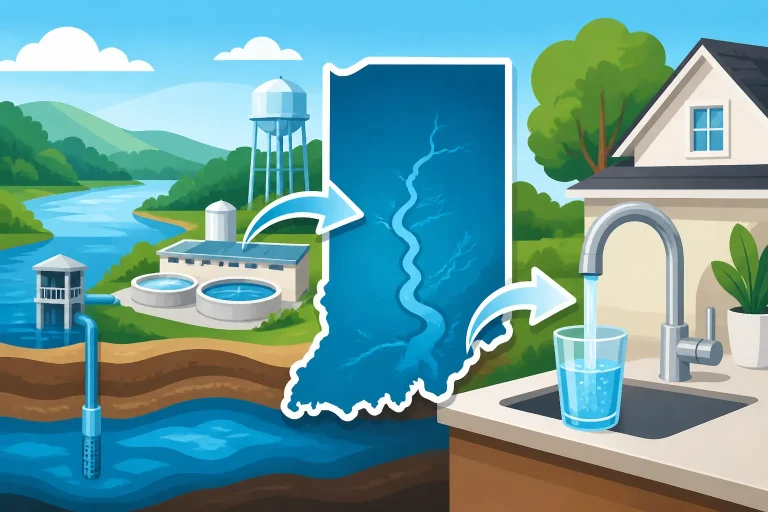
Before looking up test results, work out what kind of water supply serves the property. A home may receive water from a public utility, use a private well, or be part of a shared arrangement. The records and next steps differ, so an address search is most useful once you know which category applies.
For a home on public water, check a recent bill, lease, closing document, or message from the property manager for the provider’s name. If you do not have those documents, ask the landlord, seller, property manager, or local utility which provider serves the address. Do not assume the nearest city or the name on a neighborhood sign identifies the supplier: a community may buy water from another system, and service boundaries do not always follow town or county lines.
Once you have a likely provider, confirm that it serves the specific address. A provider’s service area, water source, and treatment can help you find the right records, but an address can sit near a boundary or be served by a different system than nearby homes. If an online search returns a system name, treat it as a useful lead and verify the match with the provider before relying on its report.
Indiana’s Drinking Water Viewer is a practical starting point for public-water research. According to the Indiana Department of Environmental Management, it provides information about “where your water comes from, sampling results, and who to contact.” That can help you identify a system and find the next place to check. It is not a substitute for confirming service at the property when the result is unclear.
A private well is different. Public-water records describe a public water supply; they should not be read as a test result for a nearby private well. If a property uses a well, ask the owner or seller for the well’s sampling and treatment records, and arrange testing appropriate to the property if you need current information. A nearby utility’s test results cannot establish what is in a private well.
If you are unsure whether a home uses a well or city water, City Water or a Private Well? How to Tell What Your Indiana Home Uses can help you sort out the source. For a broader explanation of public supplies, see Where Your Indiana Tap Water Comes From: A Homeowner’s Guide.
Gather a few details before searching
A small amount of preparation can keep you from confusing one utility with another. Note the full service address, including the municipality and county, and look for any provider name on a bill or tenant notice. If the home is in an apartment building, ask whether the whole property uses one public supply or whether a building owner manages an internal system.
If you are researching a property before buying or renting, ask the seller or landlord directly which provider serves it and whether the home has a private well, treatment equipment, or a service-line notice. A response in writing can help you distinguish a property-specific answer from general information about the neighborhood.
Use the Drinking Water Viewer for public-system records
The Drinking Water Viewer is designed to help people find information associated with public water supplies. Search by the system or provider name when you know it. If you start with an address, use the result to identify the system, then confirm with the provider that it serves the property. The search result is a starting point, not proof that a particular kitchen tap has been sampled.
According to the Indiana Department of Environmental Management, the Viewer provides “monitoring/sampling schedules, drinking water sample results, and other information.” The schedule can help you understand what monitoring is listed for the system, while the results show what has been reported in the records. If you are trying to investigate a specific concern, check the system identity and the sample details rather than relying only on a map marker or a short summary.
A useful first pass is to note the system name, the listed source and treatment information, the type of result you are looking for, and the date or period associated with that result. Then open the underlying record or report where available. A search page may summarize records, but the details matter: a sampling result has context, and a system-level result does not necessarily represent a sample collected at your exact tap.
The Viewer can also be useful when you do not yet know whom to contact. IDEM says it includes information on who to contact for a public supply. Use the contact information shown to ask about records that are not clear, an address that appears to be outside the service area, or a result that you cannot match to a particular question. For current contact details, use the official agency or provider website.
Search with the right system name
A provider’s everyday name may not match the name used in a database. A city, water company, or regional supplier can have a formal system name in state records. Try the name shown on a bill or report first, and compare it with any system name displayed in the Viewer. If the names differ, ask the provider whether the records belong to the supply serving the address.
Avoid treating a nearby system as the correct one just because its records are easier to find. If the Viewer returns more than one possible match, compare the listed area and provider details, then confirm with the utility. If no result appears, check whether the provider has a different formal name or ask the provider which public water system identification it uses in state records.
Use the schedule and results for different questions
A monitoring schedule and a sample result answer different questions. A schedule tells you what monitoring is listed for the system; a result tells you what a particular sample reported. Neither one, by itself, answers every question about the water at a particular home.
For a specific substance, look for the substance name, the sample or reporting period, and any explanatory notes provided with the result. If the Viewer shows a schedule but no result that answers your question, ask the provider whether more recent sampling information is available or whether the sample was taken at a location relevant to your concern. The distinction is especially important when you are investigating lead, which can be affected by plumbing within a property.
For help separating a system result from a household tap sample, see System Sampling Sites vs. Your Kitchen Faucet: Where Utilities Test. If your question is about how public water is regulated and monitored, How Indiana Public Drinking Water Is Tested and Regulated offers more context.
Check the Consumer Confidence Report and the public-water database
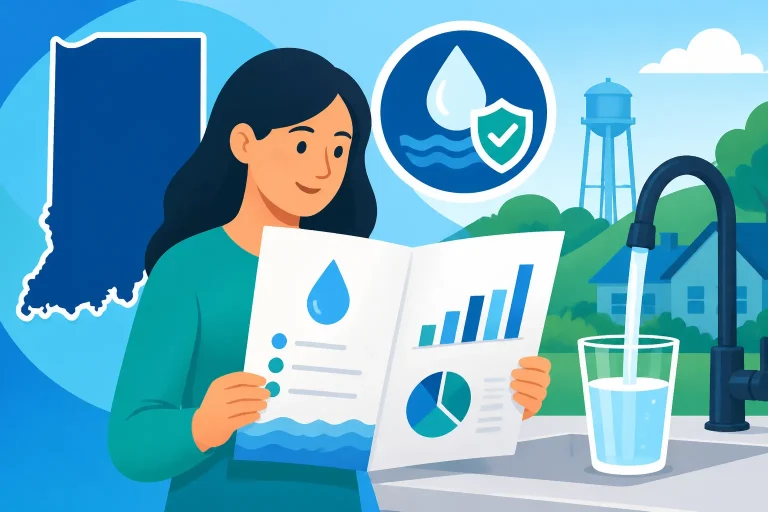
A Consumer Confidence Report, often called a water quality report, is one of the most accessible summaries for a community water supply. According to the Indiana Department of Environmental Management, community water supply Consumer Confidence Reports are available “via your water provider or through the Drinking Water Viewer.” If you cannot find one in the Viewer, check the provider’s official website or ask the provider how customers can obtain it.
A report is useful for understanding the system’s reported water quality over the period it covers. Read the reporting period before interpreting the results. A report that is easy to find is not automatically the newest report, and the period covered may not match the date you are searching. For help distinguishing a report’s publication date from the year of water data, see Which Year Does an Indiana Water Quality Report Actually Cover? and Is the Newest Annual Water Report Already Out of Date?.
The Indiana Public Water Supply Database is another place to look. According to the Indiana Department of Health, it provides information on source water, treatment, population served, names and addresses, and “results of the most recent chemical and bacteriological testing conducted.” It can complement the Drinking Water Viewer by offering system details and recent testing information. Use the database’s system name and address information to check whether you have found the right supply.
The database and the Consumer Confidence Report serve related but different purposes. The database can help identify system characteristics and locate recent test information. The report gives customers a formatted overview of a community supply. If the two sources appear to show different dates or levels of detail, do not assume one is wrong. They may present different kinds of records or cover different periods. Check each record’s context and ask the provider to explain any mismatch.
Read the report for the question you have
It is easy to open a report and focus on a contaminant table without checking the rest of the document. Start with the system name and reporting period. Then look for the substance or topic you care about, the reported result, and any notes explaining how to interpret the table.
A detected result is not automatically the same as an exceedance of a legal limit, and a result in a system report is not a measurement of every household’s water. The table may summarize samples collected at designated system locations rather than at your tap. The report’s notes, definitions, and accompanying explanations matter. For more help, see Detected Substances in an Annual Water Report: How the Table Is Built and Does a System-Wide Report Describe the Water at Your Own Indiana Tap?.
If you are trying to understand a particular row, check the units and the meaning of the reported value before comparing it with a standard or another result. Some reports show a range, an average, or a detection statement, and those terms are not interchangeable. Indiana Water Test Results Explained: MCLs, Action Levels and Units can help with the terminology, while Lead Row in a Water Report: Reading Range, Action Level, Sites Over focuses on a common source of confusion.
Look beyond the report when it does not answer your question
A Consumer Confidence Report is a system-wide summary, not a complete record of every sample or every concern. If you need details that the report does not include, ask the water provider which records are available and whether they relate to the issue you are investigating. You can also check the Viewer for sampling information and the public-water database for recent testing records.
Be precise when you ask. For example, say whether you need information about a particular substance, a reporting period, the source water, or a sample at a particular location. That makes it easier for the provider to direct you to a relevant record instead of sending another general report.
Check the dates and limits of each record
“Current” can mean different things depending on the record. It may mean the newest report posted, the latest sample result available, the current monitoring schedule, or the latest information about a service line. These records update on different schedules, so there is no single date that makes every source current for every question.
Start by looking for the date or period attached to the information itself. For a report, check the period of water data it covers, not just when you downloaded it. For a sample result, note when the sample was taken or reported if that information is shown. For an inventory, check the details and status associated with the property or line. If a page does not make the date clear, ask the provider or the responsible agency which record is newest.
The word “recent” in a database description is helpful, but it should not be treated as a guarantee that a result answers a question about today’s water at one home. A sample gives information about the sample collected under the conditions and at the location described in the record. It cannot necessarily show what happened later, what is happening inside a home’s plumbing, or what is present in an untested private well.
Think of a record in layers:
- System identity: Does the record name the provider that serves the property?
- Record type: Is it a monitoring schedule, a sample result, an annual report, or an inventory?
- Date and period: When was the sample taken, and what time span does the report cover?
- Location: Does the record describe a system location, a source, or the property’s own tap?
- Purpose: Does it answer the specific concern, or is it general background?
- Follow-up: Is there a contact listed who can clarify details or provide another record?
If two sources seem inconsistent, compare those layers before drawing conclusions. One may describe source water, another treated water, and another a customer-facing summary. They may use different dates, locations, or categories. Ask the provider to explain the difference and identify which record is relevant to your question.
For questions about lead, the annual report is especially easy to misread as a property test. It can provide useful system context, but a system-wide result cannot establish whether lead is present at a particular faucet. If you need to know about your home, consider the service line material, indoor plumbing, and a properly collected tap sample. See When a Tap Test Tells You More Than the Utility’s Annual Report for a closer look at when a household sample may help.
Look up service-line information separately
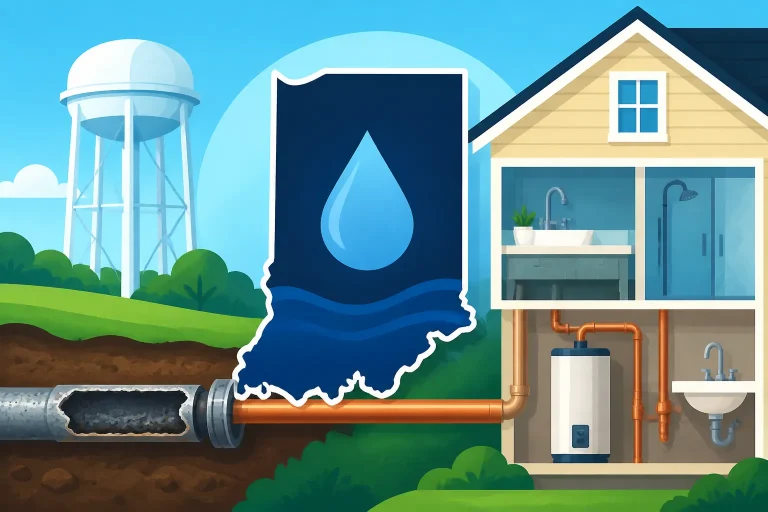
A water-quality report and a service-line inventory are not the same record. The report describes system water quality, while service-line information concerns the pipe connection that brings water to a property. A home can be served by a public system and still have a question about the material of its own line or plumbing.
According to the Indiana Department of Environmental Management, service line inventories submitted to IDEM can be viewed on “120Water’s ‘Service Line Inventory – State of Indiana’ site.” Use the inventory to look for the property’s service-line information, but read the entry carefully and check how the material is described. If the address is missing, the material is uncertain, or the entry does not seem to match what you know about the property, contact the water provider and ask how to verify it.
An inventory is not a tap-water test. It can help you understand what the utility has recorded about a service line, but it does not by itself measure lead at a faucet. Likewise, a line listed as non-lead does not establish that every component inside the home is free of lead-containing materials. Home plumbing and fixtures can be separate from the service line.
If an address has an “unknown” or incomplete entry, do not interpret that as a confirmed material. Ask what information the provider used, whether the owner can provide documentation or arrange an inspection, and what steps the utility recommends to confirm the line. A property owner’s records, an earlier inspection, or a physical check may help, but the provider can explain what it accepts for its inventory.
For a step-by-step approach, read How to Check Both Sides of Your Indiana Service Line by Address. It explains why the utility-owned and customer-owned portions may need separate attention. Who Owns Which Part of an Indiana Water Service Line? can help clarify which entity to ask about each section, and No Map Result for Your Address? Asking for a Service Line Check covers what to do when an online lookup does not return a clear entry.
If your service-line record raises a lead concern, do not assume that boiling the water or relying on a general water report resolves it. Check the provider’s directions and consider an appropriate tap sample. Lead in Indiana Service Lines and Home Plumbing: A Homeowner’s Guide explains the distinction between service lines and plumbing inside the home, while Lead Filters for Indiana Homes: Certifications, Types and Upkeep covers how to evaluate a filter against a test result.
Match the next step to the water problem
Public records are a good way to understand a water system, but the right next step depends on what prompted the search. A question about a provider’s source is different from a sudden change in taste, a lead concern, a boil-water notice, or a private-well result. Identify the problem before deciding which record or person can help.
If the water looks, smells, or tastes different
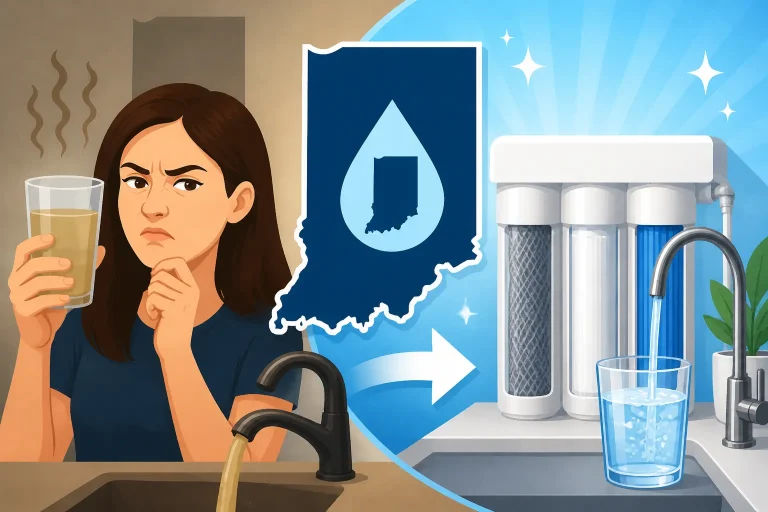
Check whether the change affects one faucet, several taps, the whole property, or nearby homes. A change at one fixture may call for a different investigation than a change throughout the home or neighborhood. Ask the provider whether there is a known maintenance issue, flushing, outage, or notice affecting the area. Follow any specific instructions the provider gives.
A change in appearance or taste does not, on its own, establish whether water is safe or unsafe. Avoid guessing based only on odor or color. For a practical starting point, see Taste, Odor and Color Problems in Indiana Tap Water: Where to Start and Utility Problem or Your Own Plumbing? How Indiana Homeowners Can Tell. If the issue seems to affect several homes, contact the provider; if it is isolated to a fixture, ask whether household plumbing should be checked.
If you are concerned about lead
Use the service-line inventory to check the recorded line information, then ask the provider how to verify any uncertain entry. A system report can provide context, but it is not a measurement of your home’s faucet water. A tap sample collected using the proper instructions can address a different question from a utility-wide report.
If you request a sample, follow the lab or provider’s collection directions exactly. Sampling methods can affect what the result tells you. For more, read Sampling Your Own Tap to Check What Indiana Home Plumbing Adds and First-Draw or Flushed? Collecting a Lead Sample the IDOH Lab Way. If a result is unclear, ask the laboratory or a qualified professional how to interpret it and what follow-up is appropriate.
If there is an advisory or outage
A water-quality database is not the best way to confirm whether a current advisory applies to your address or has ended. Check the utility’s current notices and use the official contact information it provides. A historic sample or report cannot tell you whether a temporary advisory is active now.
If you have a notice, read its exact wording and check which locations it covers, what actions it asks customers to take, and whether the provider has issued an update. See Boil-Water Notices and Outages: An Indiana Household Guide, Is the Boil Order Over? How Indiana Residents Can Confirm It, and Precautionary Advisory vs. Mandatory Boil Order: The Terms Compared.
If the property uses a private well
Do not use a nearby public system’s report as a substitute for testing the well. Ask for the property’s own testing history and details about any treatment equipment. If the records are old, incomplete, or do not cover your concern, contact an appropriate laboratory or local health department about testing options. For background, see Private Wells in Indiana: A Guide to the Water You Manage Yourself and How to Get Water Tested in Indiana: Labs, Kits and Costs.
A home treatment device also does not replace a test. If a test identifies a concern, match any treatment to the substance and the result, then confirm the device’s certification and upkeep requirements. Test First, Treat Second: IDEM’s Advice Before Buying a Filter explains why choosing equipment before identifying the problem can lead to the wrong solution.
Ask the right organization when records are unclear
Different questions may point to different contacts. A water provider can confirm whether it serves an address, clarify its system records, explain a current notice, or describe how to request information about a sample. IDEM’s Drinking Water Viewer can help identify public-supply information and a contact person. The Indiana Public Water Supply Database offers system information and recent testing records. The Indiana Department of Health’s Water Quality in Indiana information includes links to “compliance reports, technical assistance and public drinking water information.”
If you do not know where to begin, use the provider named in the Viewer or on a bill and explain what you are trying to determine. For example: “Does this system serve this address?”, “Which report covers the latest available testing?”, or “How can I verify the service-line material for this property?” A focused question is more likely to get you to the right record or office.
When the concern involves a sample result, include the substance name, the date, the units, and whether the sample came from a system location or a household tap. For a service-line question, give the property address and identify whether the inventory is missing, uncertain, or inconsistent with other information. Avoid sending sensitive personal information unless the provider needs it for a specific purpose.
For questions about a reported violation or technical matter, use the official agency information to identify the appropriate contact. Do not assume that a result shown in one database is a complete explanation of what happened or what action was taken. Ask which record contains the details and whether any follow-up information is available.
If a provider cannot answer a question about a private well, that does not mean the public-water records apply to it. Well owners manage a different set of testing and treatment questions. A local health department or qualified water professional can help identify an appropriate next step, especially if a test result raises a health concern. For health questions, ask a medical professional or local health department rather than relying on a general online record.
A practical checklist for a property search
Use this sequence when you need a clear picture of water information for an Indiana address:
- Confirm the source. Find out whether the property uses public water, a private well, or another arrangement. Ask the provider, owner, landlord, or property manager if documents are unclear.
- Identify the public system. If the property uses public water, locate the provider name on a bill or ask the provider to confirm the system serving the address.
- Search the Drinking Water Viewer. Review the system details, monitoring or sampling information, results, and listed contact. Confirm that the system matches the property.
- Check the report and database. Find the Consumer Confidence Report and compare its reporting period with the question you are asking. Use the Indiana Public Water Supply Database for system information and recent testing records.
- Check service-line information separately. Look up the property in the submitted inventory and ask the provider about missing or uncertain details.
- Choose a property-specific step if needed. For plumbing or lead concerns, a household sample may be more relevant than a system summary. For a private well, seek well-specific records and testing.
- Verify current notices directly. Use the provider’s current notice information for outages or advisories rather than relying on older reports.
- Ask a focused follow-up question. Include the property, record type, substance or concern, and date or reporting period so the provider or agency can direct you to the right information.
This process helps separate four things that often get blended together: the water source, the public system’s results, the pipes and fixtures at a specific property, and temporary notices. Each record can be useful, but each answers a different question. If you keep that distinction in mind, it is easier to tell whether you have found a relevant answer or need a property-specific test or confirmation.
Frequently Asked Questions
Can I find water quality information using only my Indiana address?
An address can help you identify a possible public water system, but confirm the provider with a bill, landlord, property owner, or utility. Public records generally describe a system, not a test of the water at one particular household tap.
Is the Consumer Confidence Report a current tap-water test?
No. It is a system report covering a stated reporting period. Check that period and the sample details, and remember that a system summary does not establish the result at a specific home faucet.
Does the service-line inventory tell me whether lead is in my water?
No. The inventory provides information about recorded service-line material. It does not measure water at the tap or establish the material of every pipe, fixture, or component inside the home.
What should I do if the online records do not match my address?
Ask the provider to confirm which public water system serves the property and how to check the relevant record. If the home uses a private well, request well-specific records and testing instead of relying on public-system results.
Sources
- Indiana Department of Environmental Management — Water Quality in Indiana: Understanding and Protecting Your Drinking Water (checked November 13, 2026)
- Indiana Department of Environmental Management — Water Quality in Indiana: Drinking Water (checked November 13, 2026)
- Indiana Department of Health — Environmental Public Health: Water Supply Information (checked November 13, 2026)
- Indiana Department of Health — Environmental Public Health: Water Supply Information (checked November 13, 2026)
Disclaimer
This article is for general informational purposes only and does not constitute professional advice. Laws, prices and regulations vary by location and change over time. Consult a qualified professional for guidance on your specific situation. Indiana Water Guide is not a government agency or water utility and is not affiliated with any public water system.