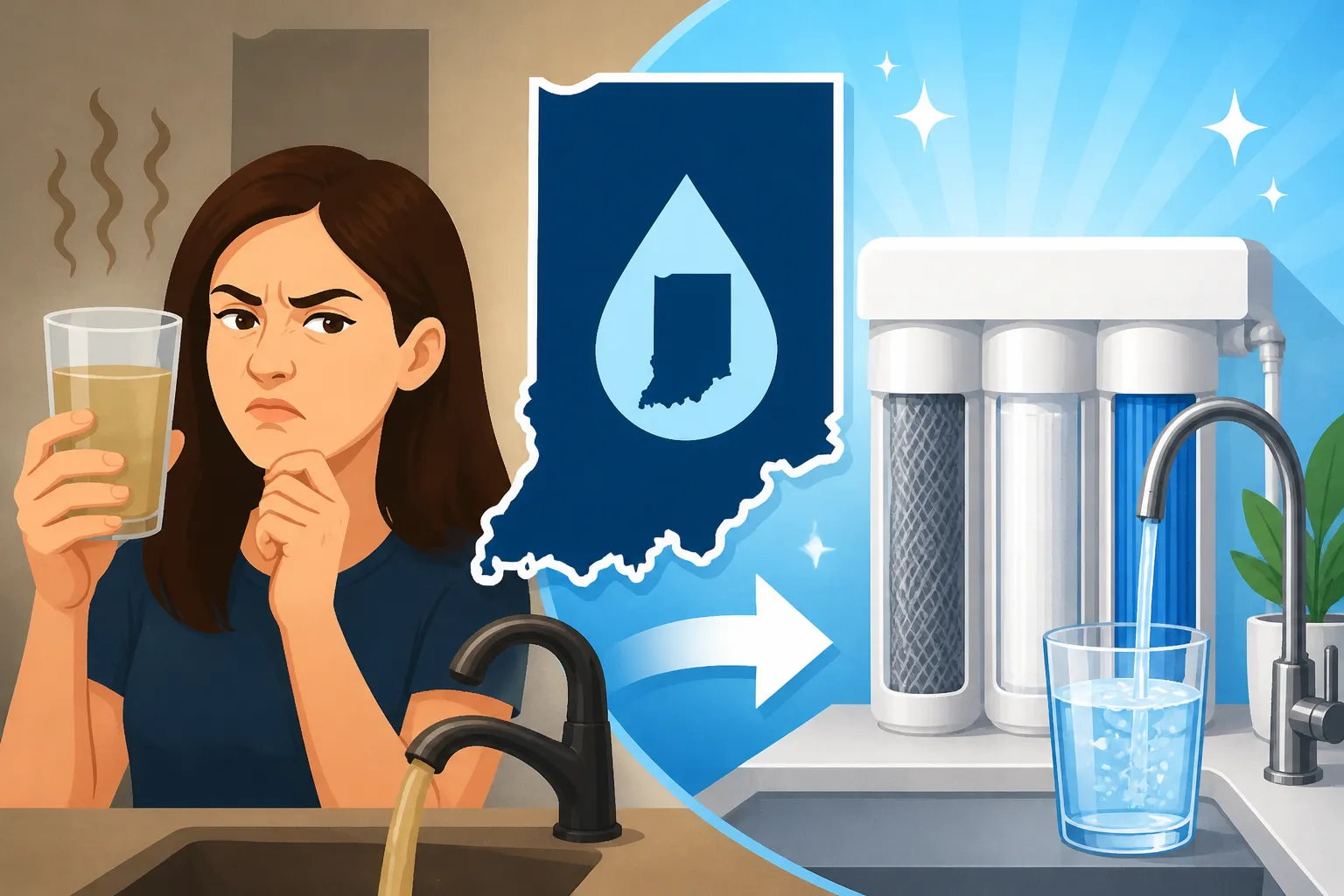
Strange-Tasting Tap Water in Indiana: Will a Filter Actually Fix It?
An odd taste can make tap water unpleasant, but it does not tell you what caused the change—or whether a filter is the right fix. In Indiana, the practical approach is to narrow down the source, check what your utility and plumbing may be contributing, and match any treatment to a confirmed problem. A filter can help with some tastes, but no single model handles everything.
Start With the Taste, Not the Filter
Taste and odor are clues, not a diagnosis. A chlorine-like smell, a musty flavor, a metallic note, or a salty taste can have different causes. Even the same description can point to different issues in different homes. Buying a filter based only on how the water tastes can mean spending money on a treatment that does not address the cause.
Indiana’s Department of Environmental Management recommends: Test your water before installing a treatment system. The agency also cautions that there is no one-size-fits-all treatment system. First work out whether the change is coming from the utility’s water, your home’s plumbing, or a particular fixture. Then choose a response that fits what you find.
Pay attention to where and when the taste occurs:
- At one tap or several? A problem at one faucet, while other taps seem normal, makes a local fixture or plumbing issue worth checking. If the taste is similar throughout the home, consider a broader source, such as the incoming water or plumbing shared by those taps.
- In cold water, hot water, or both? Compare cold water at more than one tap. If only hot water seems affected, the water heater or plumbing associated with hot water may deserve attention. A filter selected for an incoming-water issue may not address a problem that develops in the heater.
- All the time or only sometimes? Note whether the taste changes after water sits unused, after maintenance or construction nearby, or with a seasonal change. A record helps you describe the issue to the utility or a qualified plumbing professional.
- At your home or nearby too? Ask neighbors whether they notice the same change. Similar reports can be useful information for the utility, but they do not establish a cause by themselves.
- Is the water visibly different or accompanied by another concern? If the change is sudden, pronounced, or comes with an advisory or outage notice, check the utility’s current instructions before relying on taste or a household filter.
These observations help sort the possibilities; they do not prove that the water is safe or unsafe. Do not taste water to investigate it if you have reason to suspect contamination or if an official notice gives different instructions. Follow the utility’s directions, and ask the local health department or a medical professional questions about possible health effects.
For a broader starting point on unusual water, see Taste, Odor and Color Problems in Indiana Tap Water: Where to Start. If the main concern is a strong chlorine-like smell, Is a Pool-Like Chlorine Smell in Indiana Tap Water Normal? explains why that specific sensation can warrant a different line of inquiry from a general off-taste.
Check the Utility and Your Home Before Shopping
A filter can only be chosen intelligently once you have some idea of what it needs to address. Start with information that already exists, then decide whether a home sample or professional assessment is appropriate.
Check for notices and water-quality information
Look for current notices from your water provider, especially if the change is abrupt or affects a neighborhood. A taste concern alone is not a substitute for an advisory, and the absence of an advisory does not identify the cause of a taste. If there is a notice, follow its instructions rather than assuming a countertop or under-sink filter is an adequate substitute.
The utility’s annual water quality report can provide useful context about its source, treatment, and reported monitoring results. It is a system-level source of information, not a test of the water at your particular kitchen faucet. Start with Indiana Consumer Confidence Reports: How to Find and Read Yours and How to Look Up an Indiana Utility’s Source, Treatment and Test Results.
As you review the information, keep the question narrow: Does the report or utility information point to a treatment-related taste, or is it still unclear whether your home’s plumbing is involved? A report can help frame questions to ask, but a system report does not necessarily explain why one faucet tastes different from another.
If you are not sure which provider serves your address, use Finding Current Water Quality Information for Your Indiana Address to help identify where to look. For a changing taste, contact the utility through its official website and ask whether it has information about a recent change, maintenance, or a notice affecting your service area.
Compare taps and fixtures
Run a simple comparison without treating it as a laboratory test. Check cold water at more than one faucet and note whether the smell or taste is consistent. If an unusual taste appears only at one fixture, the faucet, aerator, or nearby plumbing may be contributing. A taste throughout the home suggests a broader question, but still does not tell you exactly what is present.
If the taste appears in hot water but not cold water, do not assume an incoming-water filter will fix it. The water heater or the hot-water plumbing may be relevant. A plumber can assess the fixture or plumbing when the pattern points to a home-specific source.
Also consider whether the concern is limited to drinking water or appears at other taps. A kitchen-only filter may be a practical option for a drinking-water concern, but it will not address water elsewhere in the home. Whole-house treatment has a different scope and should be considered only when the cause and treatment need justify it.
Consider a tap sample when plumbing may be involved
Indiana’s Department of Environmental Management says customers may sample their own public-supply water “if you want to know if your premise plumbing is impacting your water quality.” This is useful when the utility’s system information does not answer what is happening at your tap. A properly selected and collected sample can help distinguish between system-wide information and conditions in a particular home.
Sampling needs to fit the question. The collection method, the water source at the tap, and the laboratory analysis all matter. Follow the instructions from the utility, health department, or laboratory that will handle the sample. Do not assume a general home test kit can identify every possible cause of taste or odor.
For more on the distinction between utility information and a home sample, see Sampling Your Own Tap to Check What Indiana Home Plumbing Adds. If you are unsure what test could answer your question, How to Get Water Tested in Indiana: Labs, Kits and Costs can help you think through the process.
| What you notice | What it may help you investigate | What it does not prove |
|---|---|---|
| Taste or odor at one tap | A faucet, aerator, or nearby plumbing | That the rest of the home has the same issue |
| Similar taste at several taps | A shared plumbing source or incoming water | The identity or level of a contaminant |
| Hot water tastes different from cold | The water heater or hot-water plumbing | That a whole-house filter is the right fix |
| Neighbors notice the same change | A possible issue affecting more than one home | That the utility has confirmed the cause |
| Water tastes normal but you have a specific safety concern | Whether a targeted sample or official information is needed | That taste alone can rule out a concern |
Match the Treatment to the Confirmed Problem
A filter may improve taste, but “filter” describes many different kinds of treatment. A product designed to reduce one substance may do little for another. The right choice depends on the cause, the treatment claim for the exact model, and whether the device is maintained according to its instructions.
Indiana’s Department of Environmental Management advises that the selected treatment system should be “certified by the National Sanitation Foundation” to treat the targeted contaminants. In practice, do not stop at a brand name or broad phrase such as “water filter.” Check the exact model and the exact reduction claim. A certification or claim for taste and odor is not proof of performance for every contaminant, and one product may have different claims from another product sold under the same brand.
What an NSF/ANSI 42 claim can tell you
NSF says NSF/ANSI 42 claims may cover: Chlorine, taste and odor, chloramine, particulate, iron, manganese, zinc, and total dissolved solids (TDS). This is a category of claims to verify, not a guarantee that every device bearing a reference to NSF/ANSI 42 reduces every item on that list. Check the model’s certification details and the specific reduction claims, and confirm them with the official agency or provider when you are using the information to make a treatment decision.
NSF/ANSI 42 is often relevant when the goal is to improve aesthetic qualities such as taste or odor. But a good-tasting result does not prove that water is free of a substance you cannot detect by taste. Conversely, an unpleasant taste does not identify a health hazard. Do not choose a treatment for a safety concern based only on how the water tastes.
For a fuller explanation of what standards and product claims mean, see Making Sense of NSF/ANSI Filter Standards Before You Buy in Indiana. Check the certification for the exact product and replacement cartridge you intend to use, rather than relying on a package headline or a general description of a product line.
Select the right treatment point
Where the treatment is installed affects what it can do for your household:
- Pitcher or refrigerator filter: These can be convenient for water used for drinking and cooking, depending on the model’s specific claims. They do not treat water at every tap.
- Faucet-mounted or under-sink filter: These can treat water at a selected tap. That can be useful when the concern is limited to drinking or cooking water, but the model still has to match the target.
- Whole-house system: This treats water entering the home, so it has a wider scope and may require more planning, plumbing work, and ongoing maintenance. A wider scope is not automatically a better fit for a taste problem at one faucet.
- Water softener: A softener is designed for hardness-related issues, not as a general-purpose answer to every odor or taste. It should not be treated as a substitute for a filter certified for another target.
A water treatment device can be useful for different reasons. The Tippecanoe County Health Department describes devices as potentially “reducing health hazards such as bacteria, chemical pollutants and other toxic substances, or help remove nuisance problems such as odors or hardness.” Which of those purposes applies depends on the actual water concern and on the device’s verified treatment claims.
Treat products and claims as model-specific
If you are comparing products from Clearly Filtered or another brand, look at the documentation for the exact model you are considering. Ask what it is certified to reduce, which test or certification supports that claim, and whether the claim applies to the taste issue or contaminant you are trying to address. A recognizable brand, a long list of claimed reductions, or favorable reviews cannot replace that check.
This matters particularly when a product makes broad claims about multiple substances. Confirm that the certification covers the specific model, that the target is named in the product documentation, and that the claim fits your water test or official information. If the documentation is unclear, ask the manufacturer or the certifying organization to clarify it before buying.
For general filter selection, Getting Started With Water Filters and Softeners in Indiana covers how to approach treatment choices without assuming one device fits every home. If your main question is whether a filter can address a particular taste, Strange-Tasting Tap Water in Indiana: Will a Filter Actually Fix It? is this page’s topic, so use the other linked resources here for complementary information rather than relying on a product label alone.
Use the Filter Correctly and Recheck the Result
Even a well-matched filter is not a one-time decision. Installation, use, and upkeep determine whether it continues to perform as the manufacturer describes. Follow the instructions for the specific device, including how to install it, when to replace cartridges, and whether the system needs any special flushing or servicing.
Keep the target and the maintenance connected
Before installing a system, write down what you are trying to fix. “Make the water taste better” is a starting concern, but a more useful target might be a confirmed taste or odor issue associated with a particular substance. If you do not know the cause, the filter choice remains a guess.
Then keep the documentation for the device and replacement components. Make sure the replacement cartridge is the correct one for the filter model, and follow the maker’s directions. A device that is overdue for service or fitted with the wrong cartridge may not perform as intended. Do not assume that a filter still works simply because the water looks clear or tastes improved.
If the taste remains after installation, that does not automatically mean you need a larger system or a second filter. Revisit the diagnosis. The original cause may have been different from what the product targets, the taste may be coming from a fixture or plumbing, or the device may not be installed or maintained as directed. Check the manufacturer’s instructions and, if the issue persists, ask the utility, laboratory, health department, or a qualified professional what next step makes sense.
Do not use taste as a safety test
A filter chosen for taste is not necessarily designed to reduce a health-related contaminant. Some substances cannot be reliably detected by taste or smell, while some noticeable tastes may be nuisance concerns. A pleasant result after filtration does not verify that water meets a particular safety standard.
If you are concerned about a specific contaminant, use relevant test results or official water information to identify the treatment target. Confirm that the exact filter is certified for that target. If you have a health-related question, ask your local health department or a medical professional rather than relying on taste, online product claims, or a home treatment device as a diagnosis.
If a utility issues an advisory or gives specific directions, follow those instructions. A household taste filter is not automatically an alternative to an official advisory. For advice about an unusual taste during a notice or service disruption, see Boil-Water Notices and Outages: An Indiana Household Guide.
A practical decision sequence
Use this sequence to avoid buying equipment before you understand the problem:
- Describe the change. Note the taste or odor, which taps are affected, whether hot or cold water is involved, and when the change occurs.
- Check for an official notice. Look at your provider’s current information and follow any instructions that apply to your address.
- Compare the pattern. Check other taps and, if useful, ask whether nearby households notice a similar change. Treat these comparisons as clues, not proof.
- Review utility information. Look at the system’s report and ask the utility whether it has relevant information about your concern.
- Test when the question calls for it. If you need to know whether home plumbing is affecting water quality, ask about an appropriately collected sample and analysis.
- Choose treatment only after identifying a target. Check that the exact model is certified to treat that target and fits the place where you need treated water.
- Maintain the device and assess the result. Follow the manufacturer’s instructions. If the taste persists or the concern changes, revisit the cause rather than assuming that more filtration is the answer.
This approach is slower than ordering the first filter that promises better-tasting water, but it reduces the chance of treating the wrong problem. It also helps you decide when a filter is appropriate and when the next step should be a utility question, a sample, or a plumbing assessment.
Frequently Asked Questions
Can a filter remove a strange taste from Indiana tap water?
It can, if the taste is caused by something the exact filter is certified to reduce and the device is used as directed. A taste or odor claim does not mean the filter treats every possible cause. Identify the likely source and verify the specific model’s claims before buying.
Should I buy a filter before testing my water?
Indiana’s Department of Environmental Management recommends testing water before installing a treatment system. If you do not know what is causing the taste, a filter purchase may be a guess. Start with utility information and a comparison of taps, then ask whether a sample is appropriate.
Does NSF/ANSI 42 mean a filter removes every taste or odor?
No. NSF says NSF/ANSI 42 claims may cover substances or qualities including chlorine, taste and odor, chloramine, particulate, iron, manganese, zinc, and total dissolved solids. Check the exact model’s certification and its specific claims, and confirm them with the official agency or provider.
What if only one faucet tastes strange?
A problem limited to one fixture makes the local faucet, aerator, or nearby plumbing worth checking. Compare it with other taps and consider asking a qualified plumbing professional to assess the fixture. A whole-house filter is not automatically the right response to a single-tap issue.
What if the water tastes fine but I am worried about safety?
Taste cannot confirm that water is safe or show that a particular contaminant is present. Check your utility’s information and arrange appropriate testing when needed. For health questions, ask your local health department or a medical professional.
Sources
- Indiana Department of Environmental Management — Water Quality in Indiana: Understanding and Protecting Your Drinking Water (checked November 13, 2026)
- Tippecanoe County Health Department — Home Water Treatment Equipment | Tippecanoe County, IN (checked November 13, 2026)
- NSF (checked November 13, 2026)
Disclaimer
This article is for general informational purposes only and does not constitute professional advice. Laws, prices and regulations vary by location and change over time. Consult a qualified professional for guidance on your specific situation. Indiana Water Guide is not a government agency or water utility and is not affiliated with any public water system.